Oct 18, 2026 · Research log
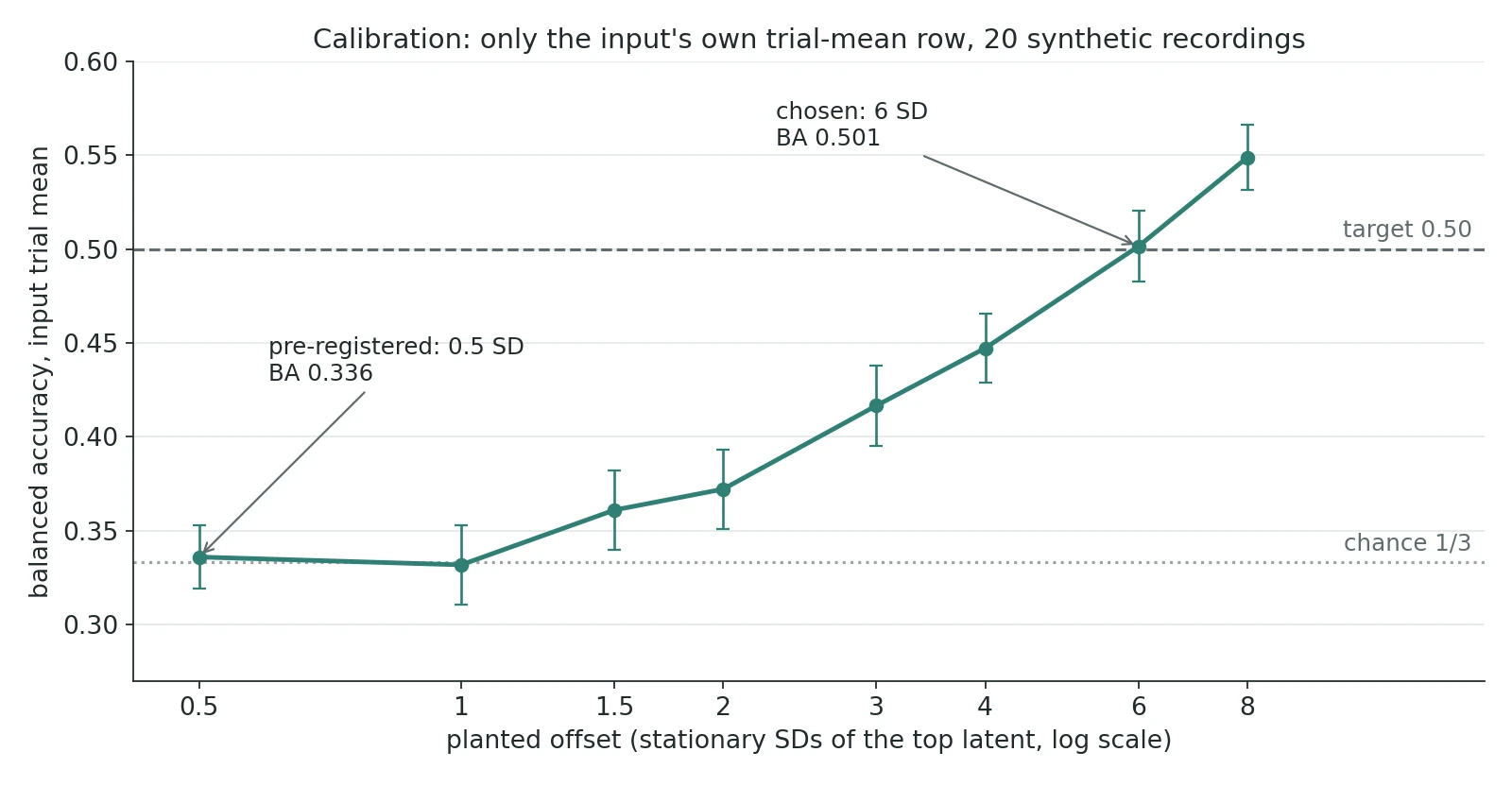
The last direction of the loop asked whether a latent trained with the label in the loop reads better than a static projection; its synthetic gate failed because the planted effect was invisible to the input's own trial mean, the recalibrated rerun passed but favoured the label-free twin, and the real-data input gate then stopped the direction.
preregistrationresearch methodologystate-space modelssynthetic validation
Read the entry →
Oct 18, 2026 · Research log
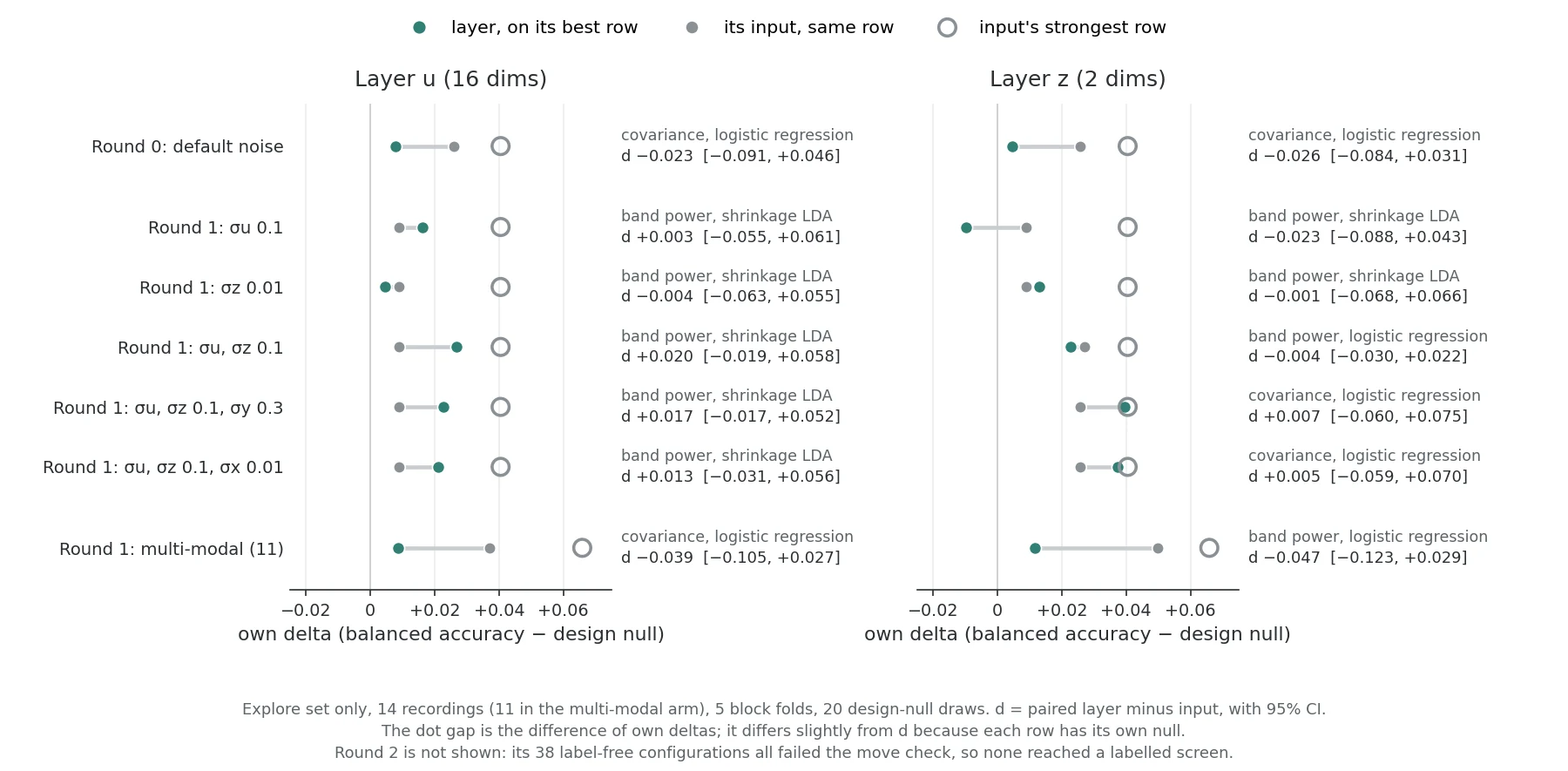
Probing a latent layer against chance is the wrong test when the layer is a filter of its input. Against the input itself, on the explore half of an explore/confirm split, under block folds and a design null, no HLDS layer showed a significant gain in seven labelled configurations, and 38 more never got far enough to be screened.
state-space modelspreregistrationrepresentation learningresearch methodology
Read the entry →
Oct 18, 2026 · Research log
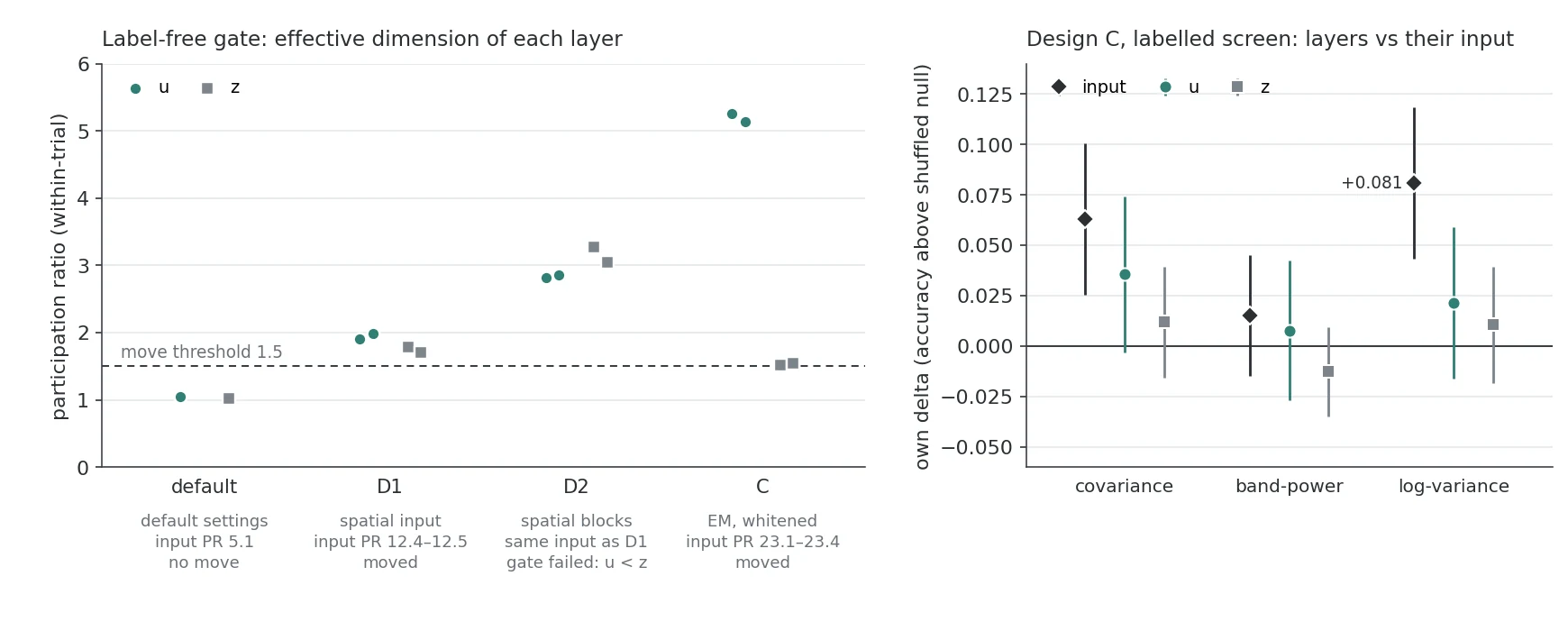
Giving the model a richer input and fitting it by expectation-maximization (EM) made its upper layers use more dimensions, one of them about five instead of one, but in the labelled explore screen neither layer decoded the three conditions as well as the input it was built from.
state-space modelspreregistrationrepresentation learningresearch methodology
Read the entry →
Oct 18, 2026 · Research log
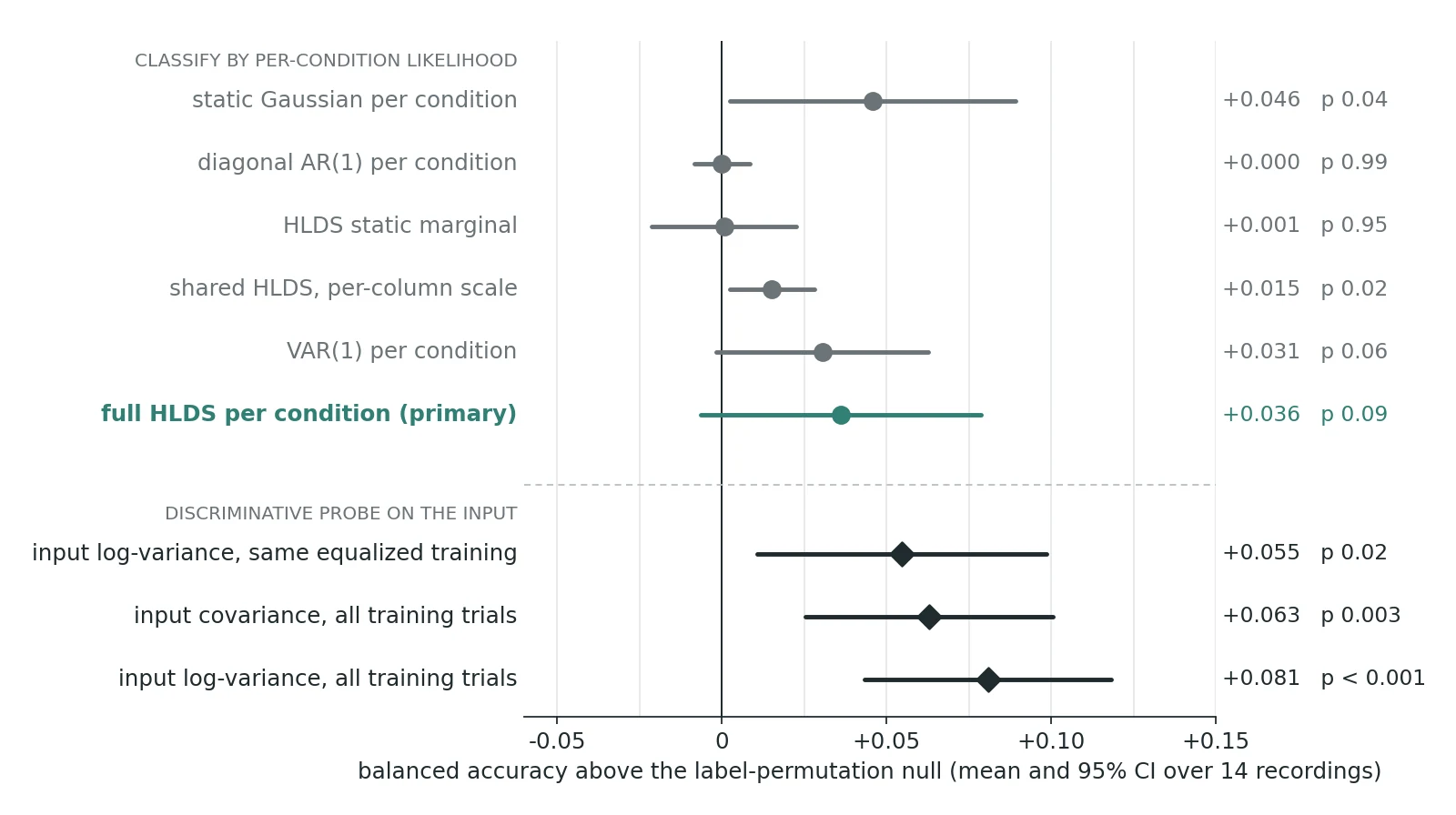
A per-condition HLDS that classifies by likelihood passed a synthetic check for planted dynamics, then failed every pre-registered item on the 14 explore recordings; a static per-condition Gaussian did at least as well, and temporal structure added nothing measurable.
state-space modelsgenerative classificationpreregistrationtime-series classification
Read the entry →
Oct 15, 2026 · Research log
Written targets, a promotion rule from small screens to large grids, bit-for-bit gates and canaries let a fast experiment loop stay honest; most of what the gates caught was plumbing, and one catch was a conclusion we had drawn too early.
research methodologyhpcscientific machine learningreproducibility
Read the entry →
Oct 15, 2026 · Research log
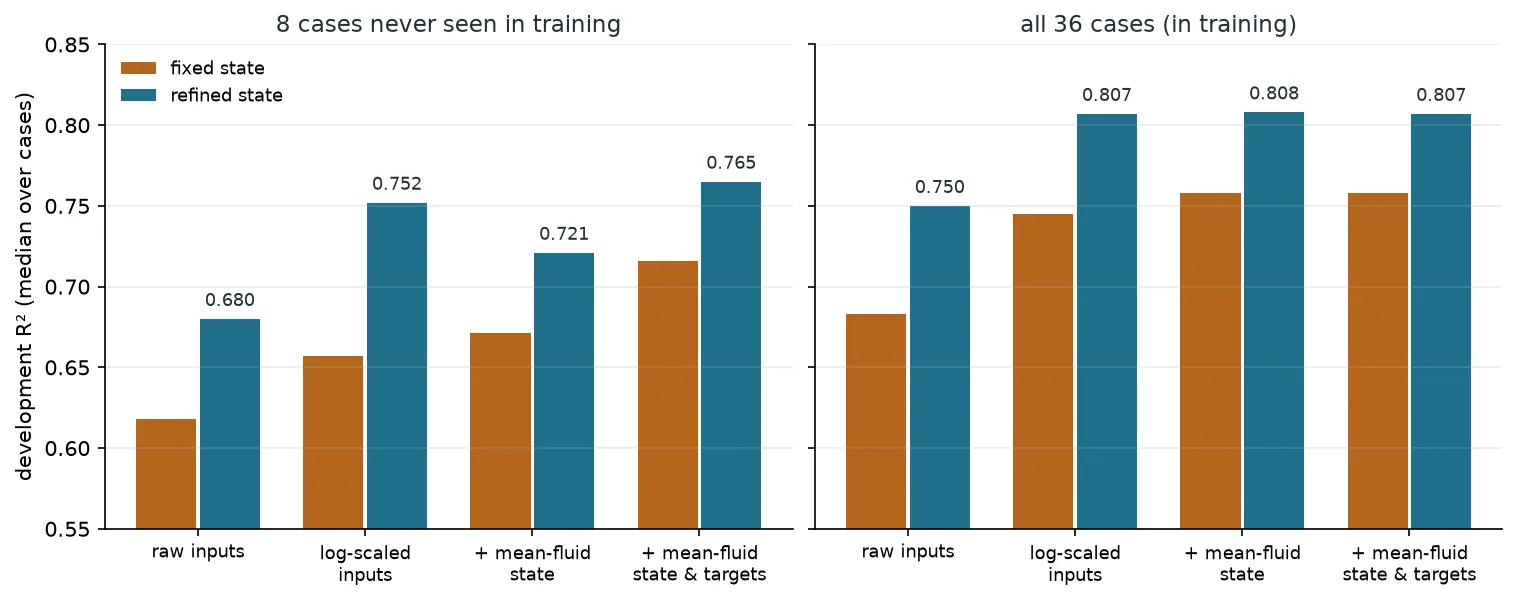
A shared model for 36 suspensions failed on unseen cases until two inputs were put on a log scale; a physics correction to the reference frame helped further, while width and depth changed almost nothing.
scientific machine learninggeneralizationfluid dynamicssurrogate modeling
Read the entry →
Oct 15, 2026 · Research log
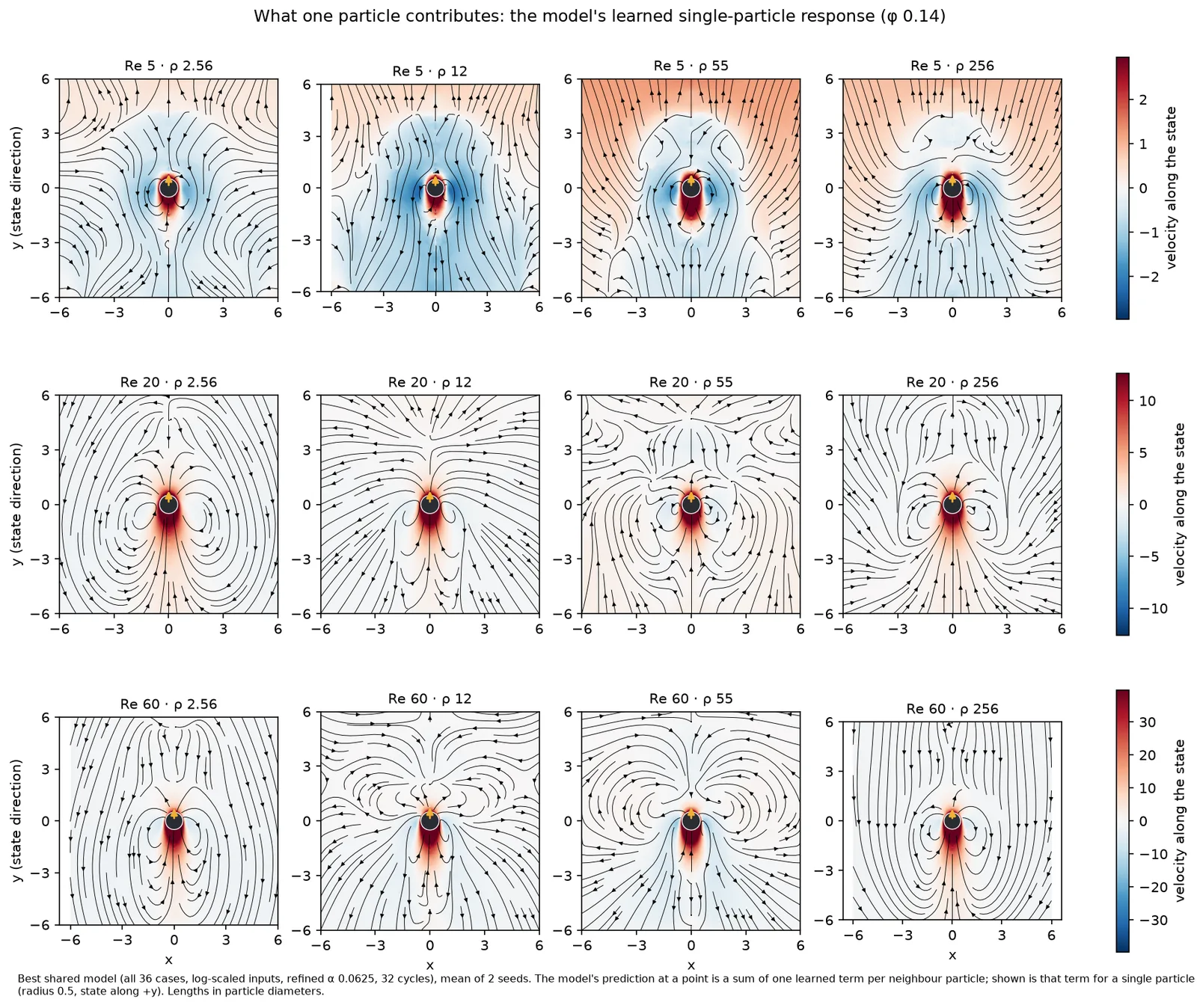
One equivariant network, evaluated once per neighbouring particle and summed, reconstructs particle-resolved flow; an outer loop that makes each particle's state consistent with its neighbours adds the most where particles crowd.
scientific machine learningfluid dynamicsequivariant networkssurrogate modeling
Read the entry →
Oct 15, 2026 · Research log
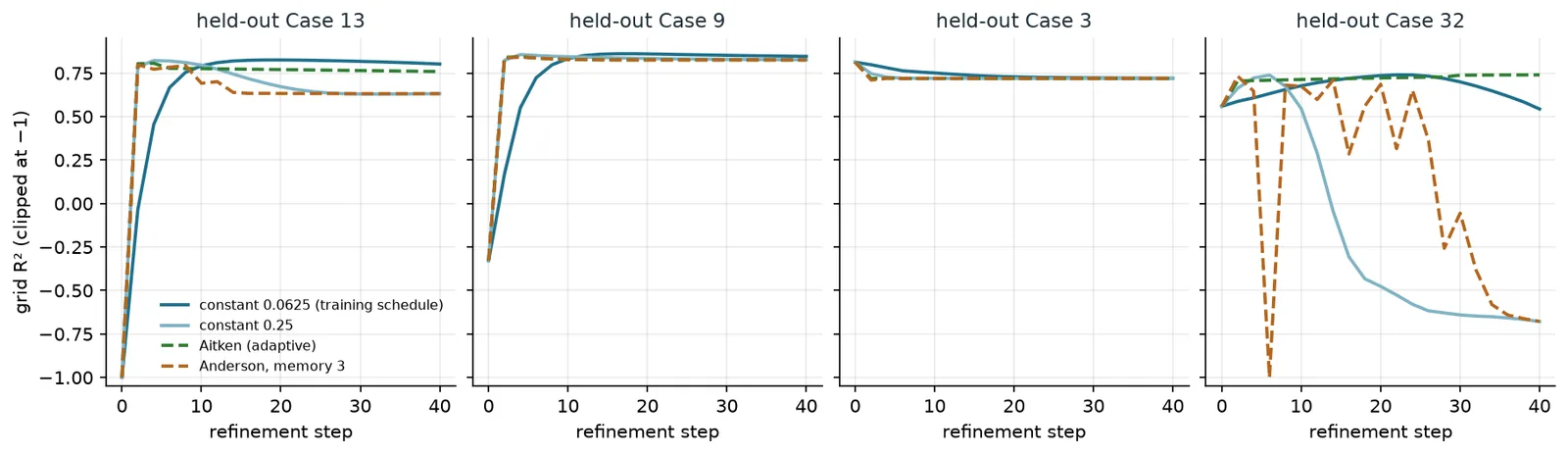
Adaptive and accelerated step rules failed during training because the map they iterate changes every cycle; at inference, where the map is fixed, they converge quickly to a fixed point that predicts worse than the partly converged state.
fixed-point iterationscientific machine learningoptimizationfluid dynamics
Read the entry →
Sep 8, 2026 · Research log
A mechanics engine for lifters is only trustworthy if the outputs it cannot support are unreachable by construction, not merely omitted from the current release.
biomechanicssoftware designverificationdigital twins
Read the entry →
Sep 8, 2026 · Teaching
A workshop number only counts once something the author did not derive agrees with it; when it does not, the notebook says so instead of hiding it.
teachingnumerical verificationoptimizationjupyter
Read the entry →
Sep 8, 2026 · Design log
Gradus grades and diagnoses with rules, not a model, so every outcome is reproducible; the price is a heavy authoring contract and an audit for hollow content.
adaptive learningdeterministic gradingproduct designeducation
Read the entry →
Sep 8, 2026 · Research log
Locked memos, validity gates, and paired-seed statistics turned a memory-architecture idea into a program where a negative result is as usable as a positive one.
kernel methodspreregistrationsequence modelingresearch methodologyhpc
Read the entry →
Sep 8, 2026 · Design log
The capture loop closed with hand-dialed recipes plus a longitudinal log; the Sony live push arrived last, set four of six fields, and was an optimization.
photography toolingfeedback loopscamera sdkproduct designlocal-first
Read the entry →
Jul 30, 2026 · Research log
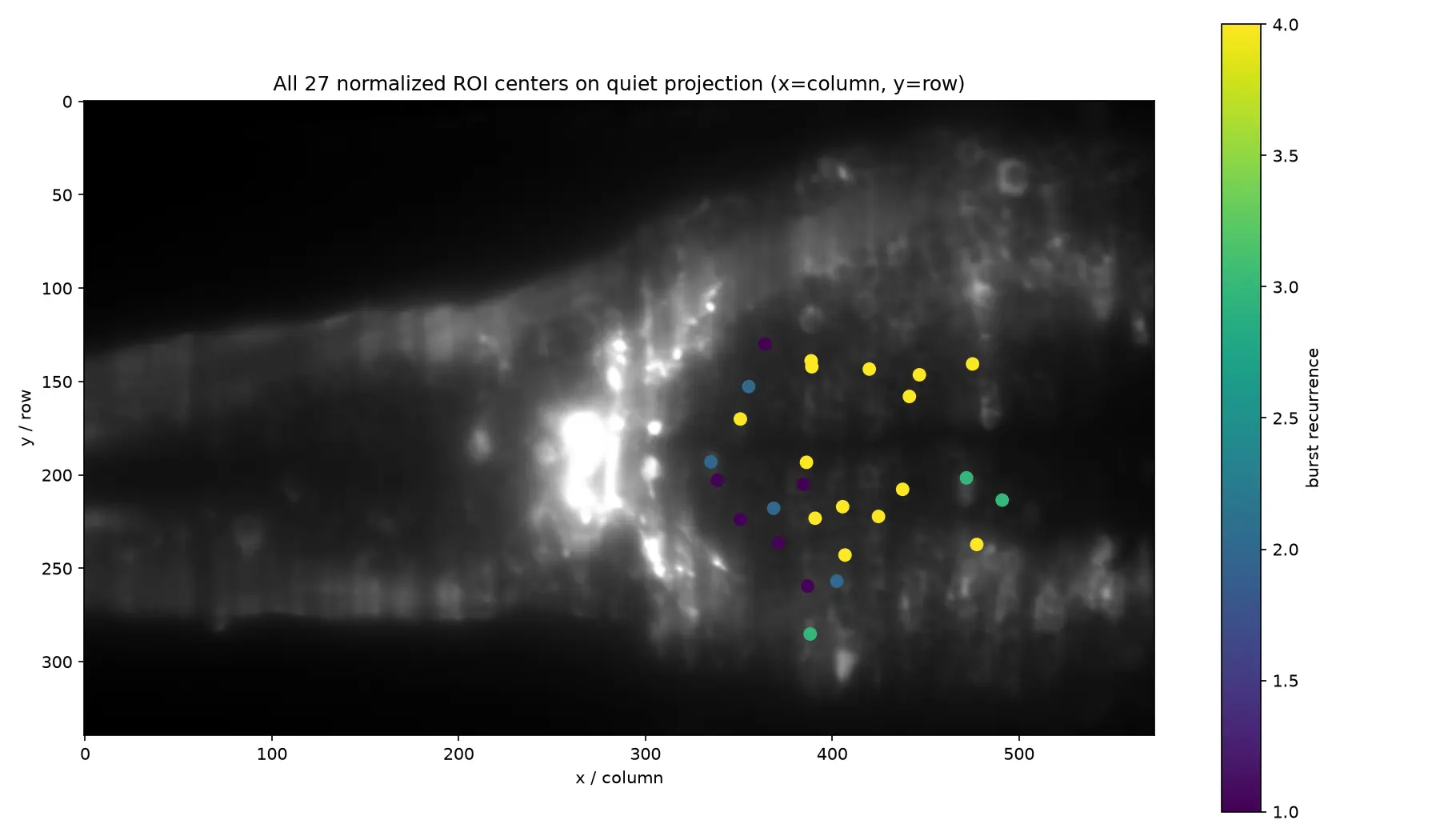
The strongest result was not a single winning denoiser: preserving the activity carrier and using spatial separation features for ranking proved more reliable.
calcium imagingsource separationsignal processingneuroengineering
Read the entry →
Nov 1, 2025 · Research log
EEG work gets more informative when temporal structure is part of the model instead of something the pipeline averages away.
eegstate-space modelssignal processing
Read the entry →
Oct 1, 2025 · Hardware
Biosignal research gets cleaner when hardware, firmware, and modeling are treated as one system instead of three separate concerns.
eegemghardwareneuroengineering
Read the entry →
Sep 1, 2025 · Teaching
Workshop design works better when theory and application are taught as one loop instead of two separate tracks.
teachingmachine learningjupyter
Read the entry →