Overview
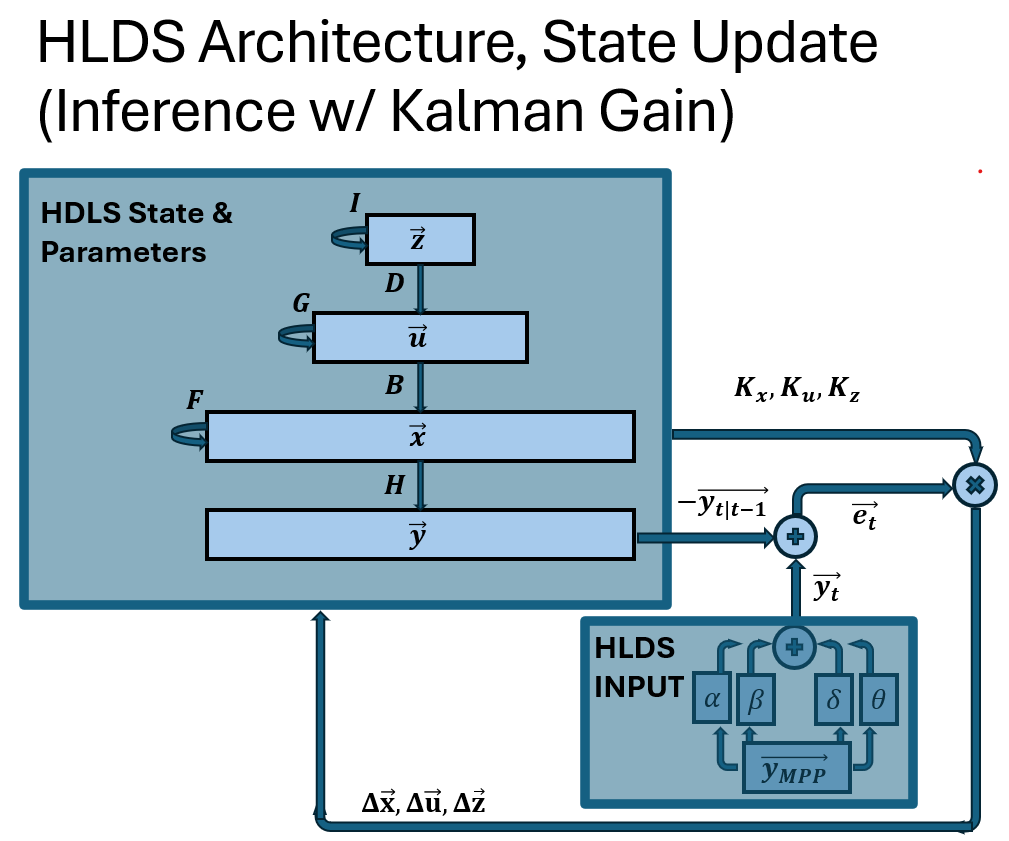
Pipeline that turns brain-wave recordings (EEG) into a small set of hidden time-series ‘states’ using a state-space model (Hierarchical Linear Dynamical System, HLDS), then evaluates those states for prediction and separability.
In this work, I focused on making brain-signal modeling practical: take raw EEG recordings collected while participants view media, clean and standardize them, fit a time-series model that tracks a few hidden variables over time, and produce clear metrics and reports so results are comparable across sessions and subjects.
What I built
- A reproducible data pipeline (loading → cleaning → segmentation → feature preparation) that turns raw EEG into model-ready inputs.
- Training and evaluation scripts for a state-space model called a Hierarchical Linear Dynamical System (HLDS), used to track hidden ‘brain state’ trajectories.
- Diagnostics and scoring outputs (e.g., stability checks, prediction metrics, and class/condition separability summaries).
- Automated summaries and artifacts so runs can be audited and compared (configuration capture, standardized outputs, and plots).
How it works
- EEG is cleaned and aligned into consistent time windows.
- The HLDS model learns hidden variables that evolve over time and explain the observed EEG signals.
- Those hidden variables (and model outputs) are evaluated against labels/conditions to test whether the model captures meaningful structure.
Deliverables
- Run folders with configs, logs, metrics, and plots.
- A standardized summary table used for comparison across papers/conditions.
Related writing
Related projects